

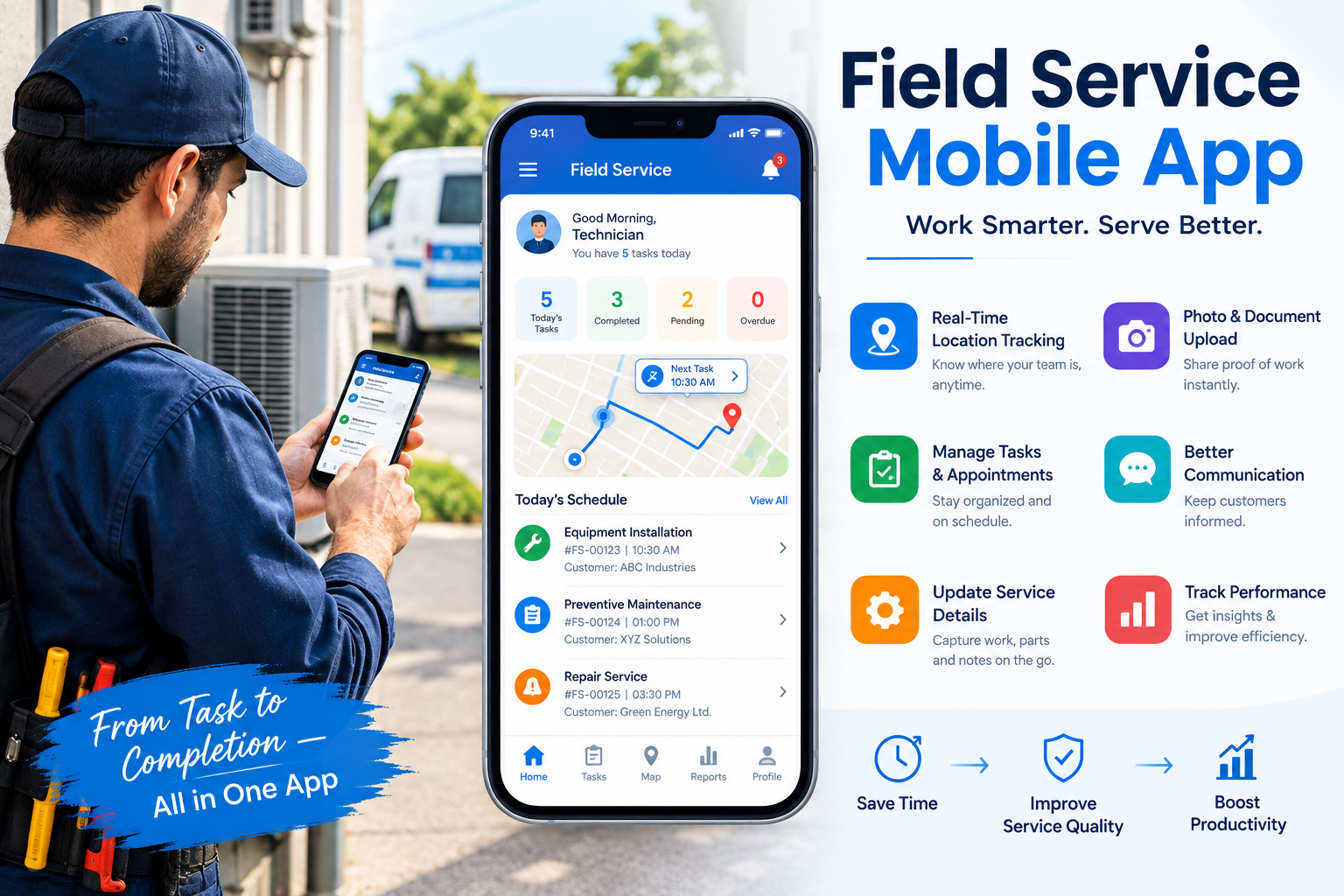
Every field service business has the same limited resource: time. Technicians have only so many working hours each day, customers expect appointments to happen as promised, and dispatchers must constantly balance planned work with unexpected requests. When those hours are poorly organized, productivity can decline quickly.
Effective field service scheduling helps organizations use their available workforce more intelligently. It involves much more than placing appointments on a calendar. A strong scheduling process considers technician skills, location, workload, job priority, travel requirements, and changing conditions throughout the day.
When these factors are coordinated effectively, businesses can reduce operational friction while giving technicians a more practical working schedule.
The Daily Challenge of Coordinating Field Teams
Field service environments are constantly changing. A schedule created in the morning can become outdated within hours.
An emergency request may arrive. A technician could encounter a complicated assignment that takes longer than expected. A customer might cancel at short notice. Traffic conditions can also affect arrival times.
Field service scheduling provides a framework for managing these variables without losing sight of the wider operation.
A Full Calendar Is Not Always an Efficient Calendar
Filling every available appointment slot may appear productive, but excessive scheduling can create problems.
Technicians need realistic travel time between locations. Some jobs naturally require more time than others. Unexpected complications must also be considered.
A schedule that leaves no flexibility can quickly fall behind after a single delay.
Effective planning therefore focuses on achievable workloads rather than simply maximizing the number of appointments assigned.
Match Technician Skills With Job Requirements
Not every technician is equally suited to every assignment.
Different jobs may require particular experience, technical knowledge, qualifications, or familiarity with specific equipment. Assigning work without considering these requirements can increase the likelihood of delays or repeat visits.
Field service scheduling can help planners consider employee capabilities when distributing work.
Better Matching Supports Better Preparation
The right assignment gives a technician a stronger opportunity to complete the job effectively.
Before allocating work, planners can consider the nature of the request alongside technician skills and availability. This reduces the risk of sending someone who may require additional assistance after arriving.
Better matching can also increase technician confidence because employees receive assignments aligned with their capabilities.
Control Travel Without Sacrificing Service Quality
Travel is necessary for field work, but unnecessary travel creates no direct customer value.
Poor scheduling may send employees across large service areas even when more logical assignment sequences are available. Over a full week, these inefficient journeys can consume substantial working time.
Field service scheduling can help planners consider location alongside other operational requirements.
Think in Terms of the Entire Working Day
The closest technician is not automatically the best choice.
A nearby employee might have another appointment in the opposite direction shortly afterward. Assigning the new job could create additional travel later.
Planners should therefore consider the technician’s complete schedule rather than looking at one appointment in isolation.
This broader approach can produce more practical routes and reduce unnecessary movement.
Handle Urgent Jobs More Effectively
Unexpected work is one of the biggest tests of a scheduling process.
Urgent assignments cannot always wait for an open appointment slot. Dispatchers may need to reorganize existing workloads while minimizing disruption for other customers.
Strong field service scheduling gives planners better visibility into where flexibility exists.
Protect the Rest of the Schedule
Reacting to an emergency should not automatically create several additional problems.
Before reallocating a technician, planners can examine current workloads, locations, job priorities, and upcoming commitments.
This allows teams to respond to urgent requests while considering how each change affects the rest of the working day.
Balance Workloads Across the Workforce
Workload imbalance can reduce overall efficiency.
One technician may receive too many assignments while another finishes early. The overloaded employee faces increased pressure and a greater risk of delays, while unused capacity elsewhere goes to waste.
Field service scheduling helps organizations distribute assignments more thoughtfully.
Build Realistic Technician Workdays
Balanced scheduling does not necessarily mean giving every employee exactly the same number of jobs.
One technician may handle several short appointments, while another completes fewer complex assignments. Travel distances and job requirements also influence workload.
The objective is to create practical schedules based on actual effort rather than appointment counts alone.
Improve the Customer Experience Behind the Scenes
Customers rarely think about scheduling systems. They care about whether the technician arrives as expected and whether the service process feels organized.
However, those outcomes depend heavily on what happens before the technician reaches the location.
Field service scheduling supports more realistic appointment planning, helping businesses avoid commitments that their teams are unlikely to meet.
Predictability Builds Trust
Customers value reliable communication and reasonable appointment expectations.
When schedules account for travel and realistic job duration, technicians have a better opportunity to arrive within the expected timeframe.
Consistency can strengthen customer confidence and reduce frustration caused by repeated delays or last-minute changes.
Use Operational Patterns to Improve Future Schedules
Scheduling should become more informed over time.
Every completed assignment provides useful information about job duration, technician capacity, travel requirements, demand patterns, and scheduling accuracy.
Managers can examine this information to understand where planning assumptions need adjustment.
Learn From Repeated Scheduling Problems
Suppose a certain type of assignment consistently takes longer than planned. Future schedules can allocate additional time.
Likewise, if a particular service area regularly creates excessive travel, planners can reconsider how jobs are grouped.
Field service scheduling becomes increasingly valuable when organizations use previous experience to refine future decisions.
Give Dispatchers Greater Operational Control
Dispatchers often work under considerable pressure. They must make rapid decisions while considering customers, technicians, locations, priorities, and deadlines.
Without clear scheduling visibility, those decisions can become reactive.
A structured process gives dispatchers a stronger understanding of current workloads and available capacity.
Make Changes With Confidence
Good scheduling does not eliminate unexpected situations. Instead, it helps teams manage them more effectively.
When planners can understand how one adjustment affects other assignments, they can make changes with greater confidence and less disruption.
That flexibility is particularly important for organizations managing large or geographically dispersed field teams.
Conclusion
Successful field operations depend on making smart decisions about limited time and workforce capacity. Simply assigning jobs to available technicians is not enough. Businesses must consider skills, travel, priorities, realistic job durations, workload balance, and unexpected changes.
Field service scheduling brings these considerations together within a more organized planning process. It can help reduce wasted travel, improve technician utilization, support more dependable appointments, and give dispatchers greater control when plans change.
Ultimately, better scheduling creates value across the entire operation. Technicians receive more practical workdays, dispatchers gain clearer visibility, customers experience greater reliability, and managers can use operational patterns to make better future decisions. When scheduling becomes a strategic process rather than a basic administrative task, the entire field operation can work more efficiently.