

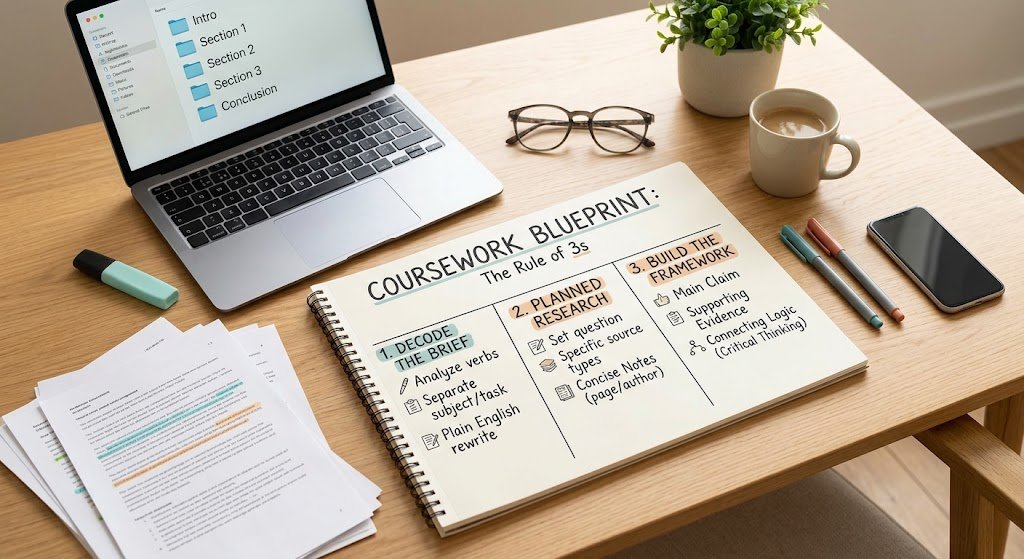
The blank page is rarely the real problem. Usually, the trouble starts earlier, when a coursework brief seems to ask you to do six things at once: understand the question, find evidence, read difficult sources, build an argument and somehow turn everything into a finished assignment.
That is enough to make almost anyone feel stuck. The answer is not to stare at the document until inspiration arrives. Break the assignment into smaller decisions first. Once you know exactly what needs doing, the writing becomes much easier to manage.
Step 1: Work Out What the Coursework Question Really Wants
Before opening Google Scholar, a library database or a dozen browser tabs, read the coursework brief carefully. The wording matters because the instruction tells you what kind of answer you are expected to produce.
Words such as analyse, compare, discuss, explain, assess and evaluate point towards different types of academic work. The exact meaning can vary between subjects and qualifications, so your module guidance and marking criteria should always take priority.
A useful trick is to separate the topic from the task. If the question asks you to evaluate the impact of a particular business strategy, the strategy is the topic. Evaluating its impact is the actual job.
Then rewrite the question in plain English. Ask yourself: What am I being asked to find out, and what do I need to do with the information I find? If you cannot answer that clearly, more research will probably create more confusion rather than solve it.
Step 2: Find the Smaller Tasks Hidden Inside the Brief
A coursework question can be surprisingly short while containing several separate jobs. You might need to explain a theory, examine different viewpoints, apply evidence to a case, discuss limitations and reach a final judgement.
Write those jobs down before you start. Your list might include:
- understanding the question and marking criteria
- identifying the main concepts or themes
- deciding what evidence you need
- finding and checking suitable sources
- organising your notes
- planning the structure
- drafting and editing
- checking references and submission requirements
This does something important: it turns one enormous task into several smaller ones.
Instead of thinking, “I have to finish my whole coursework,” you can think, “Today I need to identify the evidence for section two.” That is far easier to start, measure and finish.
Step 3: Use the Rule of 3s to Give Every Section a Purpose
Here is a simple test that can make coursework planning much easier. Before writing a major section or paragraph, ask three questions:
| The Rule of 3s | Ask yourself | What it does |
|---|---|---|
| 1. Core Point | What am I actually saying here? | Keeps the writing focused |
| 2. Supporting Evidence | What proves or supports this point? | Stops unsupported claims |
| 3. Connecting Logic | Why does this matter to the original question? | Turns information into analysis |
This is not a rigid formula for every paragraph. It is a planning tool.
For example, finding a study that reports a particular result is only part of the job. You still need to explain what that result tells the reader and why it helps answer the coursework question.
That final connection is where many assignments become stronger. Point, evidence and explanation give the reader a reason to care about the information you have included.
Step 4: Research With a Purpose Instead of Collecting Everything
Unplanned research can swallow hours. You find one useful paper, follow its references, discover another interesting argument and suddenly have thirty tabs open without knowing which sources will actually appear in your assignment.
Start with questions rather than sources. For each section, decide what you need to find out and then look for evidence that helps answer that specific point. Depending on the subject, this could mean academic journals, books, official reports, legislation, case studies, statistics or primary material.
It is also worth remembering what students are usually trying to solve when they search phrases such as do my coursework. Often, the real difficulty is not a lack of information. It is knowing what information matters, how to judge it and where it belongs in the argument.
Do not judge a source only by how academic it looks. Ask what it contributes, how closely it relates to the question and whether there are limitations you need to acknowledge.
Your notes should be useful later, not simply large. Record the main idea, where the source might fit and the reference details. For a direct quotation, note the page number immediately. Trying to rebuild your references from memory on submission day is asking for trouble.
Step 5: Separate Research, Writing and Editing
Researching, drafting and editing require different kinds of attention. Constantly jumping between them can make a simple assignment feel exhausting.
A better sequence is to understand the brief, identify what needs investigating, gather the evidence, organise your notes, create the outline and then draft.
Do not stop every few sentences to perfect your wording. Get the argument onto the page first. Once the main structure exists, you can return to improve clarity, remove repetition and tighten weak sections.
It also helps to measure progress by finished tasks rather than hours.
“Spend three hours on my coursework” is vague. “Find two reliable sources for the section on X” gives you something concrete to complete.
That small change can make study sessions feel much less frustrating.
Step 6: Watch Out for the Shortcuts That Create More Work
Writing the introduction first feels sensible because it gets something onto the page. In reality, it can be difficult to write a good introduction before you know what your main argument is going to look like.
Over-researching creates a different problem. There will nearly always be another article worth reading. At some point, you need to decide that you have enough evidence to answer the question properly.
Your notes can also become a trap. Copying long passages from sources may give you pages of material without giving you a clear understanding of what any of it means.
Try summarising the important idea in your own words instead. That forces you to process the material and usually makes the eventual writing faster.
Keep the word count in mind too. A long background section can quietly eat into the space you need for analysis, evaluation or application.
Step 7: Use the One-Minute Coursework Test Before You Draft
Before writing the first paragraph, put the coursework question at the top of your page and complete these four lines:
What is the question?
What must I prove or explain?
What evidence will I need?
What will each section contribute?
Now read your outline from beginning to end.
If every section has a clear purpose, you are ready to draft. If several sections simply say “more information about the topic”, the structure is not finished yet.
Check your marking criteria at this stage too. If the assessment expects critical analysis but your plan is mostly definitions and description, you have found a problem early enough to fix it.
Also check the practical requirements: word count, referencing style, required sources, formatting and submission instructions.
Make the Assignment Smaller Before You Make It Better
Breaking coursework into manageable pieces is not about turning a university assignment into a complicated project-management exercise. It is about removing uncertainty before that uncertainty starts eating your time.
First understand the question. Then identify the smaller tasks. Research with a purpose, organise your evidence and give every section a clear job.
The most useful mental shift is simple. Stop looking at the assignment as “a 3,000-word piece of coursework I have to finish.” Look at it as a question you need to answer, claims you need to support and smaller decisions you can make one at a time.
Once you see the assignment that way, the blank page becomes much less intimidating. You are no longer trying to write everything at once. You are simply working out what comes next.