

You’ve read the theories. You’ve cited the right academics. You’ve followed the structure to the letter. And yet, when you read your own assignment back, something feels… thin.
If that sounds familiar, you’re not alone and you’re not doing anything obviously wrong. You’re just missing the one ingredient markers at Level 7 are actually looking for: depth.
Here’s the good news. Depth isn’t a talent you either have or don’t. It’s a habit of thinking you can learn and once you see it, you can’t unsee it.
What “Depth” Actually Means (It’s Not Big Words)
A lot of students think advanced academic writing means sounding more sophisticated. More jargon, longer sentences, denser paragraphs. It doesn’t work and markers can spot it instantly. An assignment can sound impressive and still say almost nothing.
Real depth isn’t in your vocabulary. It’s in your thinking.
Take employee engagement. A descriptive answer explains a well-known model and lists its parts. That’s Level 5 work. A Level 7 answer asks harder questions: Does this model hold up across different types of organisations? What assumptions is it quietly resting on? Is there a better lens for explaining the same problem?
That’s the real shift from explaining an idea to interrogating it.
(Assessment criteria vary by provider and brief, so always check your specific guidance but this principle holds everywhere.)
The Trap: Good Research, Weak Assignment
Here’s what catches people out. Finding sources isn’t hard anymore HR research is everywhere. The hard part is knowing what to do with what you find.
You can write ten pages packed with theory and still produce something oddly empty, because you’re reporting sources instead of using them.
Watch for these red flags in your own drafts:
- A theory gets explained but never questioned
- Three sources say roughly the same thing, adding nothing new
- A company example gets bolted on after the theory instead of testing it
- A contrasting view gets one sentence, then vanishes
- The writing gets genuinely interesting but drifts away from the actual question
That last one trips up even strong writers. HR is a wide field, and it’s dangerously easy to write something smart about leadership or culture that has quietly stopped answering what was asked.
Where Real Analysis Actually Comes From
Treat your evidence like a conversation, not an exhibit.
Say a study claims a leadership style improves outcomes. Don’t just report it interrogate it. Where was it tested? Does that setting resemble yours? What else could explain the result?
Now bring in a second voice. Maybe one researcher credits leadership behaviour, while another points to systems, resourcing, or employee voice instead. That disagreement is gold it gives you something to actually analyse, instead of a list of summaries sitting side by side.
Not all sources carry equal weight, either. A peer-reviewed study, an industry report, and a practitioner blog post can all be useful but they’re not answering the same kind of question, and treating them as interchangeable weakens your argument.
This is exactly why students searching for CIPD Level 7 assignment help often still get stuck: they find plenty of information, but the real question was never “have I got enough sources?” It’s “does this evidence help me build, test, or challenge an argument?”
Turning Research Into an Argument: A Simple Sequence
Before you write a single paragraph, take the assessment question apart. Start with the command word analyse, evaluate, assess, discuss, and recommend are not the same instruction wearing different clothes. Each one asks for a different kind of thinking.
Once you know what’s actually being asked, research gets easier, because you’re hunting for something specific instead of everything.
A reliable paragraph shape looks roughly like this:
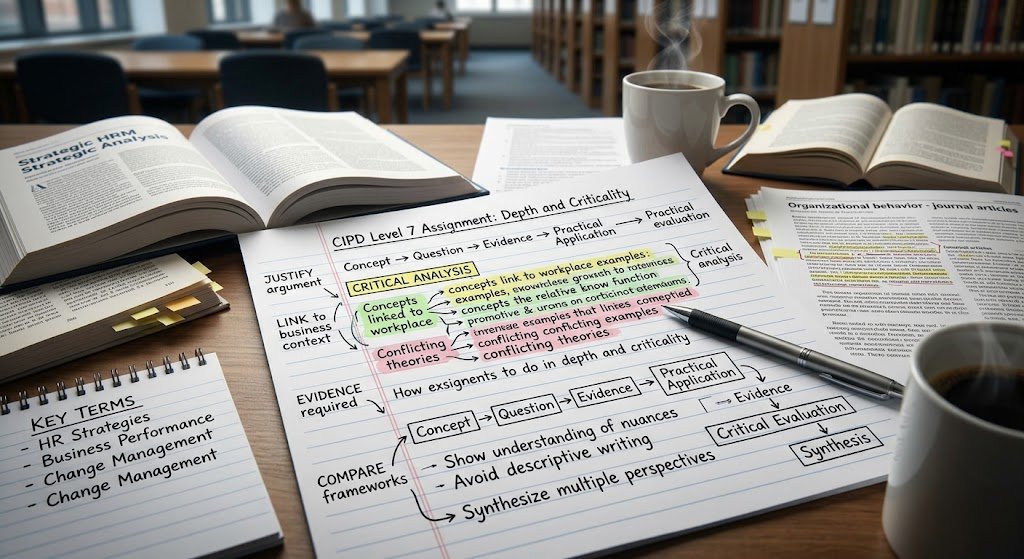
Make a point → bring in evidence → interpret it → weigh a different view → apply it to a real organisation → land on a judgement.
You don’t need to follow this like a checklist every time good writing has rhythm, not rigidity. But if that reasoning chain is missing, the paragraph is probably reporting, not analysing.
The Mistakes That Quietly Undercut a Level 7 Assignment
Theory-dumping is the biggest one. Cramming five models into two pages doesn’t prove you know more if you can’t say why each one earns its place, it’s just padding.
Another trap: assuming “critical” means “negative.” Critical analysis isn’t a hunt for flaws. The strongest work acknowledges what a theory gets right and names exactly where its assumptions stop holding up.
Then there’s the lazy application problem a paragraph on a theory, followed by a single throwaway line like “this could apply in an organisation.” That’s not application, it’s a footnote pretending to be analysis.
Ask instead: what does this specific organisational context reveal about the theory? Maybe resourcing makes it unworkable. Maybe culture flips the outcome entirely. Maybe the theory only holds under narrow conditions. That’s the version worth writing.
The Mirror Test: How to Check If You’ve Gone Deep Enough
Here’s a trick worth stealing: after writing a section, delete every citation and reread what’s left.
If what remains is just other people’s ideas restated in your own words you’re still summarising. If what remains still makes an argument, weighs it, and reaches a judgement that’s depth.
Ask yourself “so what?” after every claim. You explained the theory so what does that tell the reader? You cited the research so what can actually be concluded from it? You described the organisation so what does that change?
Look for signs you’re:
- Comparing genuinely opposing viewpoints, not just listing them
- Explaining why evidence is convincing or isn’t
- Naming assumptions instead of quietly accepting them
- Keeping the organisation in the conversation throughout, not just at the end
- Actually taking a position, rather than leaving everything balanced on a fence
The Real Takeaway
The strongest Level 7 assignments aren’t the longest, the most heavily referenced, or the most theory-dense. They’re the ones where a reader can follow your thinking from start to finish where every idea earns its place because it moves the argument forward.
So next time you sit down to write, don’t just ask what does the literature say?
Ask what does the literature let me argue?
That one shift in mindset is usually the difference between an assignment that reports research and one that actually thinks.